 Nanaimo Custom Bathrooms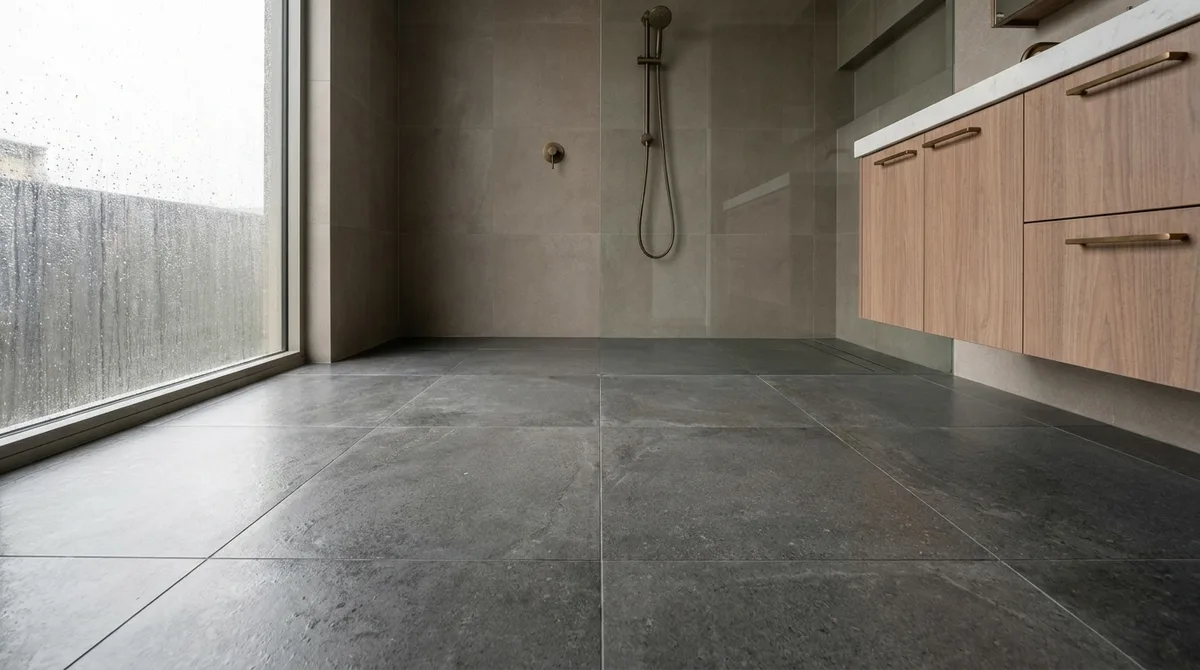
Tile as a floor is experienced every morning and every day when bare feet touch its surface. It is what you stand on barefoot when getting out of the shower, what you clean along the grout lines, what you slip on when wet, and what it is like to be in the room acoustically. Those experiential qualities are set by the format — the overall size of individual tiles — and by the grout line spacing and colour. Tile is durable and permanent, but its qualities underfoot and in the space are fundamental to daily comfort.
A small-format tile — 6 inches or less per side — has many grout lines throughout the floor. A large format — 12 inches or bigger per side — has proportionally fewer. More grout lines means more frequent cleaning required, because grout is where moisture collects, where dirt sits, and where discoloration starts. Fewer lines means faster routine cleaning and maintenance but larger individual tiles, and any manufacturing lippage or substrate flatness problem becomes more visually prominent. The choice is a fundamental trade-off between ease of cleaning and maintenance versus the visual impact of the tile field as seen from above.
Tile is hard underfoot. Over long periods of standing and walking on it, hardness is what the foot actually feels — the sound and vibration when you walk on it, the cool surface temperature, the lack of give or shock absorption. Underfoot warmth can be added with radiant heat beneath the tile, and the coldness of the surface diminishes significantly. Without radiant heating beneath it, tile naturally feels cool to the touch because it is a thermal conductor. That thermal property is not a defect; it is simply what tile is materially. Tile can be beautiful and clean, but it is not soft or forgiving underfoot.
Porcelain and ceramic are different tile bodies with distinct material properties. Porcelain is much denser — less porous, stronger, more frost-resistant, and more suitable for higher-traffic floors and wet environments. Ceramic is more porous and softer, suitable for light to moderate traffic environments. The distinction matters significantly on a bathroom floor that sees daily use and exposure to moisture. Porcelain tiles last longer in demanding conditions but cost more initially. Ceramic is adequate for typical residential bathrooms but can show wear, staining, and durability issues sooner than porcelain under intensive daily use.