 Nanaimo Custom Bathrooms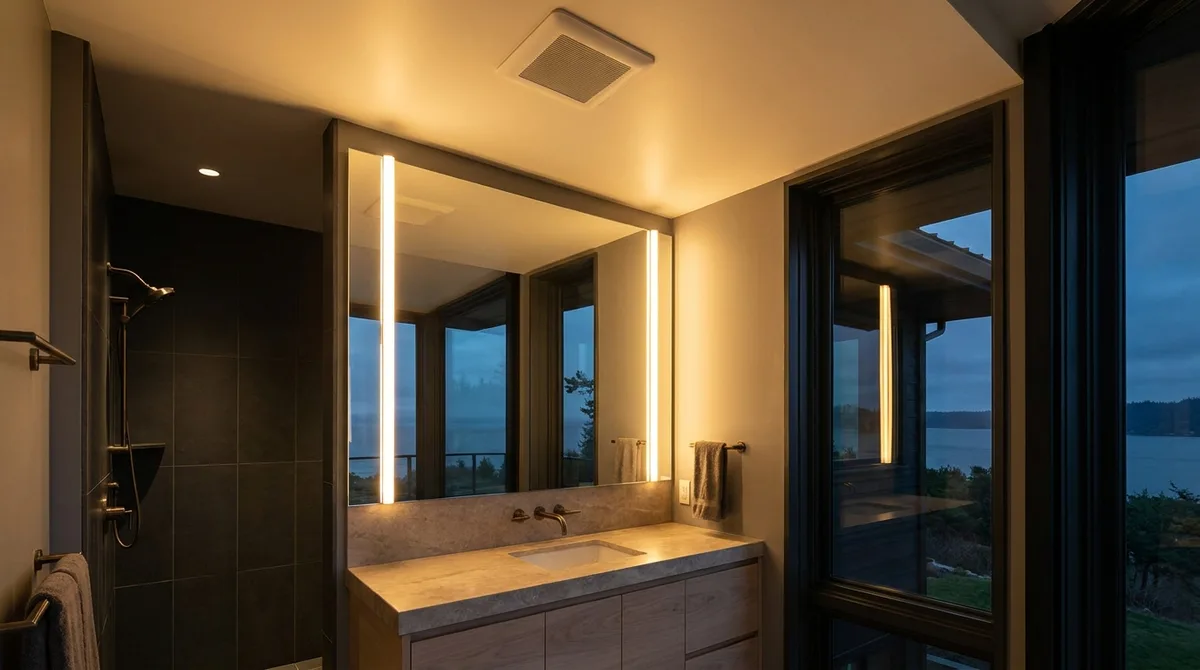
A mirror lit from above casts unflattering shadows under the eyes and cheekbones, making the face look older and more tired than it actually is. A mirror lit from the sides, at face height, washes the face in even and flattering light and eliminates those harsh shadows. Combining frontal and side light gives maximum flexibility — bright, even light for detailed grooming tasks, and softer light for evening mood and relaxation. Side light eliminates the exhausted look that top-only lighting creates.
Colour rendering index (CRI) is a measure of how faithfully a light bulb reproduces colours under its illumination. A cheap LED bulb might have CRI 70 or 80, which makes skin tones look sallow and yellowed, and makeup colours read completely wrong. A better quality bulb has CRI 90 or 95, and skin tones look honest and makeup colours are rendered true to their actual hue. That difference is meaningful every morning when someone is getting ready and every time someone looks in the mirror — bad colour rendering makes people look unhealthy.
Colour temperature affects both mood and perceived time of day. A cool white light (5000K or higher) is energizing, mimics daylight, and is ideal for the morning when people are waking up and need energy. A warm white light (2700K) is gentler and more forgiving, suitable for evening when the goal is relaxation rather than energy. The choice depends on the time of day when the mirror is most used and the mood desired in the space.
Glare is light reflecting straight into the viewer's eyes, which is uncomfortable and ruins the mirror view and task. Shading the light sources — with frosted bulbs, diffusers, or fixtures designed to eliminate direct view of the bulbs — prevents glare. Shadows at the mirror are gone when light comes from multiple angles (frontal, sides, and ideally both), but glare at the viewer can still ruin both the comfort and the function of the lighting.
Water and electricity around a bathroom mirror demand careful waterproofing and electrical safety. Lights installed above the mirror get splashing during showers. Penetrations in the wall or ceiling for electrical wiring need to be sealed carefully against moisture. Demisting heating elements behind the mirror need protection from the spray. The light fixture should be on a separate dedicated circuit and protected from direct spray with appropriate fixtures and installation height.