Skip to content
Nanaimo Custom Bathrooms

Custom Bathroom Design & Planning

Fixture & Finish Selection

The part of a shower tap that matters is the part nobody sees — the body behind the tile commits the wall, and the trim in front of it does not.

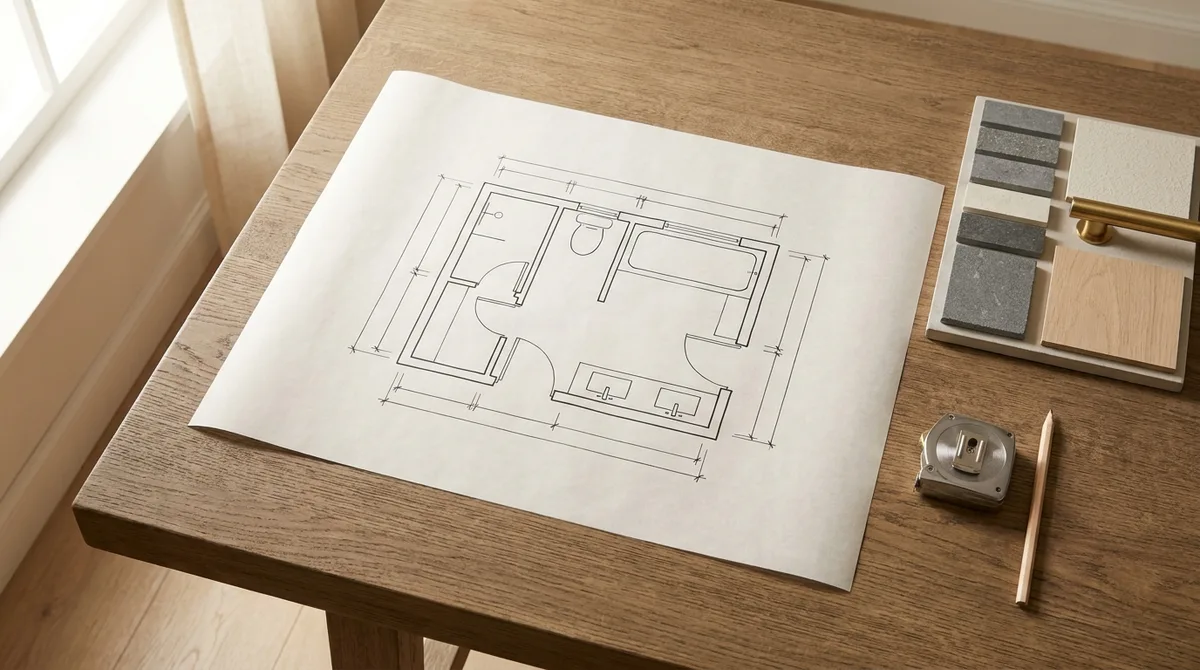
A dimensioned bathroom floor plan drawn on paper on an oak table, beside a tray of stone and tile samples, a brass bar handle, a tape measure and a pencil

What this involves

Fixture & Finish Selection

Selection is treated as the pleasant end of a bathroom. It contains one genuinely irreversible decision, and it is not the one anyone deliberates over. The visible trim on a shower — plate, handle, head — can be swapped in an afternoon. The valve body behind it is buried in the tile, and trim does not cross between manufacturers, so the body fitted at rough-in commits the wall to one range for as long as the tile lasts.

The body carries the decisions the trim only expresses. Whether the valve is pressure-balanced or thermostatic, how many outlets it has, and whether a hand shower can be added later are all settled inside the wall. So is depth: a body set too deep for the finished tile thickness leaves trim that will not reach, which is why the tile has to be known before the body is fixed.

Finish durability in a wet room is not what showroom names suggest. Chrome stays the most robust and the least fashionable. Matte black is sold in two entirely different constructions — a hard vapour-deposited coating, and a paint or powder finish of the same colour — and only the first survives being cleaned. The second chips at the aerator and around the handle base. Living brass is meant to change, and is a poor choice for anyone who does not want it to.

Water shows on some finishes and not others, and a current test beats an assumption in either direction. Scale is most visible on polished chrome and on dark matte; brushed finishes forgive it. Untreated shower glass etches permanently where hard water dries on it, which is a coating specified at order time rather than a cleaning problem to solve afterwards.

  • Licensed & insured
  • WorkSafeBC coverage
  • Written quotes & contracts
  • Built to BC Building Code

Why it matters

What you get

The buried decision made first

Valve body, outlet count and set depth against finished tile are specified before rough-in, because the trim in front can be changed later and the body behind it cannot.

Finishes chosen for the water they meet

Whether the supply runs soft or hard changes which finishes keep looking maintained, and whether shower glass needs a coating specified at order rather than scrubbed later.

Nothing left to default

Drain grate, flush plate, waste and hinges are specified alongside everything else, because small items get bought last, in whatever was in stock.

How it runs

The process

  1. 01

    Specify the body, then the trim

    Valve type, outlet count and set depth are fixed against the tile thickness, and the visible trim is taken from the same range so the two actually meet.

  2. 02

    Compare finishes in the room

    Samples are looked at in the room's own light and against each other, because two products both described as brushed nickel are routinely different colours.

  3. 03

    Check what each surface must survive

    Floor tile is checked for wet slip rating, counters for staining and UV, and cabinet construction for standing water at the toe kick, before anything is ordered.

Questions

Frequently asked

Only within the same manufacturer's range. A trim kit mounts to a specific body, and two makers' plates do not swap. The tap chosen now decides what is available in ten years, so the useful questions are whether the cartridge is a current model and whether it is stocked in Canada. Where a wall is being tiled anyway, a body with a spare outlet capped off adds very little and leaves a hand shower possible later without breaking tile.

Not inherently — it depends which matte black. A vapour-deposited finish is extremely hard and behaves much like chrome. A painted or powder-coated one does not, and chips at the aerator, at the handle base, and anywhere a cloth catches it. The second consideration is water: where the supply is hard, dried spotting shows on dark matte more plainly than on anything else. Neither point rules it out. Both are reasons to establish which construction is being bought.

Not from the photograph. Suppliers publish a wet slip figure, and the threshold commonly quoted for interior floors that get wet is a dynamic coefficient of friction of 0.42. European ranges usually carry an R rating too, with R10 typical for a bathroom floor and R11 or above for a shower floor. A polished tile has neither. Texture is a trade-off: heavy texture grips and holds soap scum, so a fine matte with the rating behind it is usually better.

Specify the parts that cannot be changed

Valve bodies, finishes and floor ratings settled before rough-in, while each of them is still a choice.