 Nanaimo Custom Bathrooms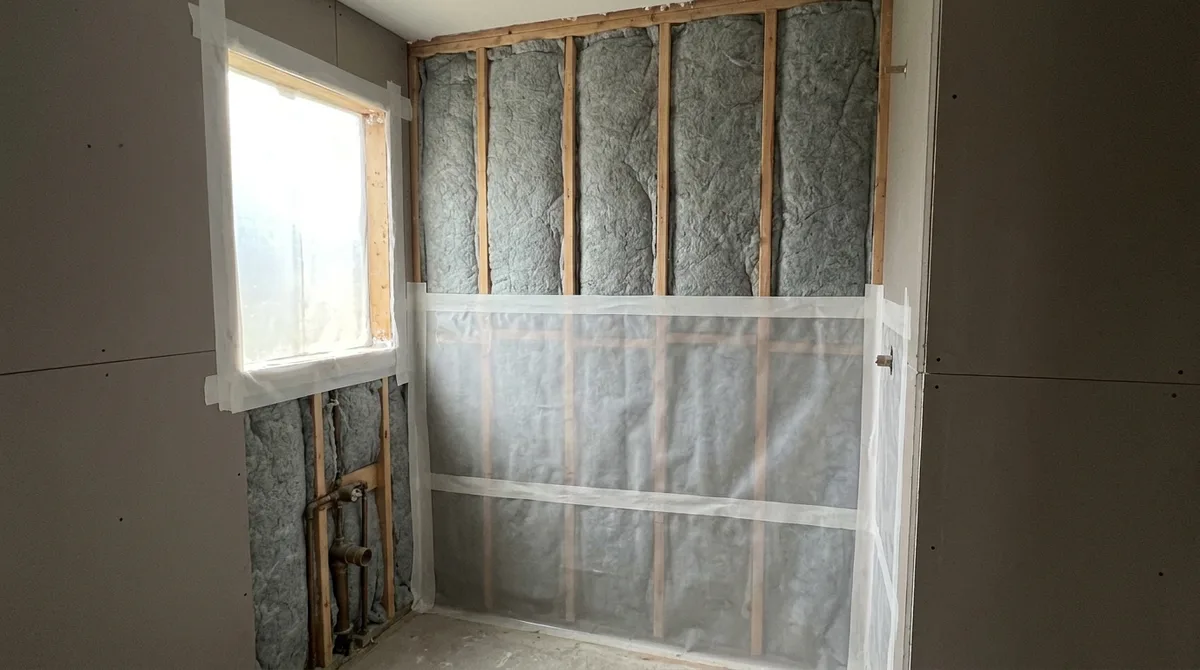
A bathroom is an assembly. Every component — walls, floor, fixtures, finishes — will get wet at some point. The specification is a set of trade-offs between a material that tolerates water and a detail that keeps water away from an ordinary material. The honest premise is that wet is inevitable. The design choice is how to handle it.
Some materials resist water inherently. Ceramic tile does not absorb water — water runs off or sits on top. Metal does not absorb water. Plastic does not absorb water. Stone resists water better than wood. Other materials absorb water readily. Wood absorbs water. Drywall absorbs water. Plaster absorbs water. The first group of materials can be in the wet zone. The second group has to be in the dry zone, or has to be sealed so water does not penetrate.
The trade-off is between using a material that resists water in a location where water will happen, or using an ordinary material and detailing carefully so water is kept away from it. Using tile in the wet zone is the first approach. Using painted drywall with sealed junctions is the second approach. Both work. The choice is made based on where in the room the water risk is highest.
Fixings are the parts that fail quietly. A screw holding a fixture is steel. Steel corrodes in water. After months or years, the screw rusts and the fixture starts to loosen. The fastener that seems insignificant is the one that causes problems. Stainless steel fasteners resist corrosion. Fasteners in the wet zone, or fasteners that are exposed to water or humidity, should be stainless. Fasteners in the dry zone can be ordinary steel. This is a detail that nobody sees, but it decides whether a fixture stays tight or slowly works loose.
The parts nobody sees — behind walls, inside cavities, under floors — are where the specification actually matters. A wall behind tile has insulation, vapour control, a seal at penetrations. If any of these details is wrong, water gets into the cavity and damage starts. The cavity is inaccessible, and the damage is invisible until it is severe. This is why the work behind the finish is more important than the finish itself.
The ceiling has a vapour control layer and insulation above it. If this is not right — if vapour can condense inside the cavity — mould grows on the back of the ceiling and the structural members rot. The inside of the cavity is inaccessible and the problem is invisible until it is catastrophic. The specification of what goes above the visible ceiling is more important than the ceiling finish itself.
The strategy is to assume every part gets wet, and to design the assembly so water is either shed immediately or kept away from materials that fail when wet. Tile sheds water. Sealed junctions shed water. Vapour control keeps water vapour away from cold surfaces. Insulation keeps surfaces warm. Ventilation removes humid air. Together, these details make a bathroom that resists water and resists the decay that follows.