 Nanaimo Custom Bathrooms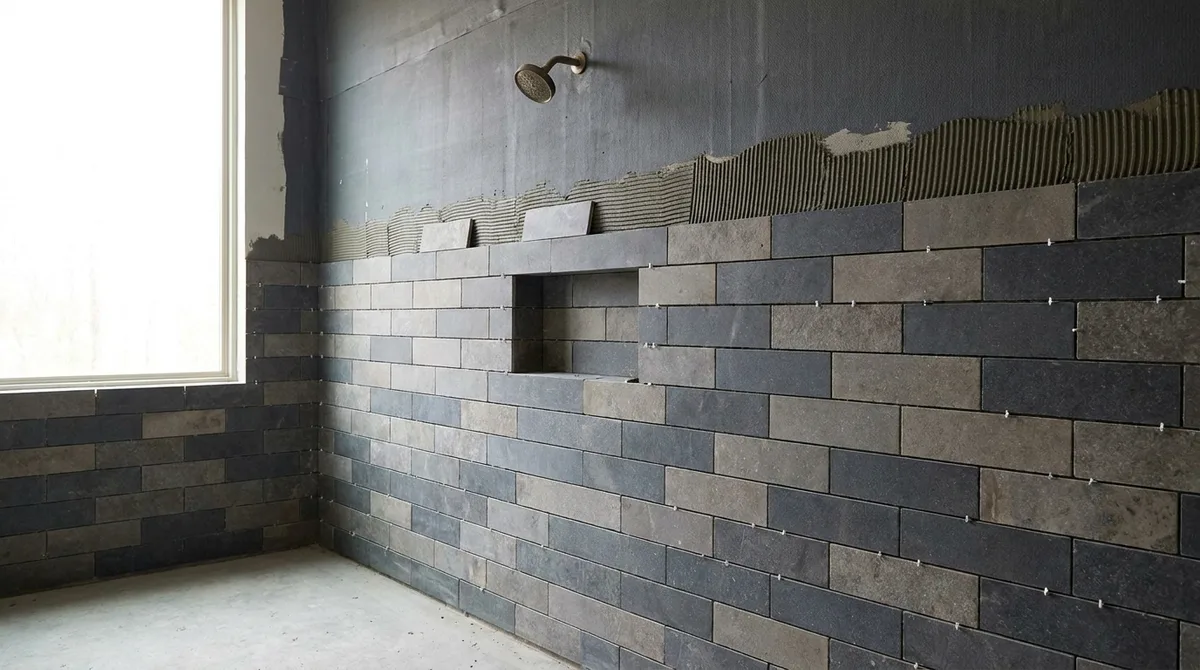
The three things that decide whether tile looks right and stays put are what is behind the tile, what is between the tiles, and how the tiles themselves land. Behind the tile is adhesive coverage—full-bed adhesive across the back of the tile versus dabs at the corners. Between the tiles is the joint—its width chosen for the tile's own size variation, and grout colour changing how the whole field reads. How the tiles themselves land is lippage—the slight vertical difference where adjacent tiles do not finish at exactly the same height.
Lippage is exposed by raking light. Shine a light across a tiled field and every slight height difference shows as a shadow line. Some lippage is unavoidable; even high-quality tiles have dimensional variation. The question is whether that variation is allowed to accumulate, showing clearly in the raking light, or whether it is managed during installation so the eye does not catch it. This cell owns lippage between tiles—the craft decision about how tiles are set so the field reads as flat, even when the tiles themselves have slight dimensional variation.
Full adhesive coverage is more important as tile format grows. A small tile on dabs of adhesive is stable; a large tile is not. The adhesive spreads the load and prevents flexing and cracking. The bed is combed with a notch trowel so there are ridges in the adhesive; the tile presses down and the ridges compress, creating continuous contact. The depth of the ridges matters; too shallow and the tile does not bed fully. Too deep and the adhesive is not squeezed out completely, leaving voids.
The joint width is chosen for the tile itself—its size and dimensional tolerance. A large-format tile with tight tolerances might be laid in a tight joint. A handmade tile with variability might need a wider joint to accommodate the inconsistency and still keep the field looking level. Grout colour is what you see in the finished field. A light grout makes the joints read as lines across the tile. A dark grout makes the tile read as separate objects. Matching grout to the tile colour makes the joint disappear. The choice is not right or wrong; it is about what visual effect you want.
Movement accommodation is about living with the materials you have installed. Tile expands and contracts with temperature. Grout cracks if the movement is constrained. At perimeters and internal corners, the joint has to be wide enough and flexible enough to let the tile and substrate move independently without loading the grout. This is not a visible detail in the finished floor, but it is the difference between a tiled floor that moves quietly and one that cracks over time.