 Nanaimo Custom Bathrooms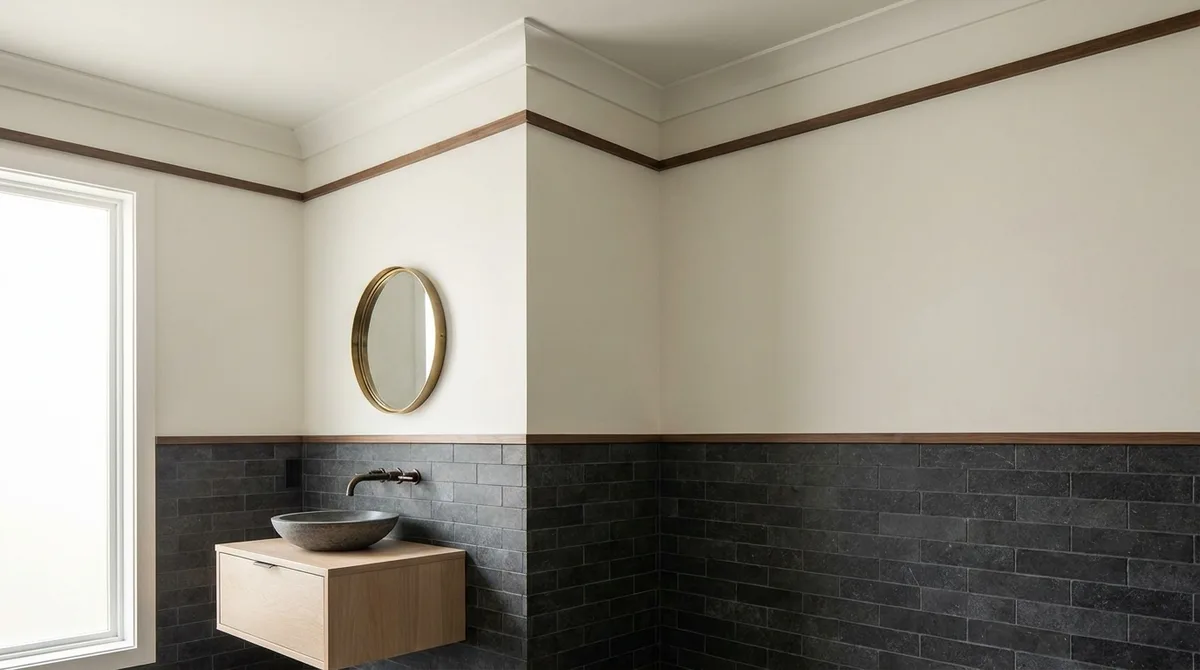
The ceiling is the plane the room's warm, wet air reaches first. When someone showers, the air rises and hits the ceiling before it hits any wall. The ceiling stays warm and damp for longer than the walls do, because moisture condenses on it and the surface stays wet. This is different from the walls, which may dry between showers. The ceiling asks something different of a finish than a wall does.
Flat paint is the universal choice for ceilings, even in bathrooms where walls get satin or gloss. Flat paint on a ceiling does not show glare, does not bounce light around the room, and does not make the space feel claustrophobic the way glossy paint can. The colour is almost always white or near-white — not for looks, but because light ceilings feel higher and larger. A dark ceiling absorbs light and makes the room feel small and low.
The ceiling is full of holes. Every light fitting is a hole. Every exhaust grille is a hole. Sometimes there is an access hatch for mechanical work above. Every hole is a penetration through the one plane that is meant to shed water and keep it out of the structure above. Each hole has to be closed neatly, both for how it looks and for how water behaves around it.
A light fitting in a ceiling is a hole that goes through the finish, the structure, and into the cavity above. The fitting has to be sealed around the edges so water does not run down into the wall below. If the fitting is recessed, the trim ring sits flush. If it is a surface-mounted fitting, it sits on top and the hole gets sealed. Either way, the edge detail is the point where water and air flow is controlled.
An exhaust grille is another hole. The grille face sits in the ceiling, but behind it is a duct that runs to the outside or to a vent stack. The seal around the grille matters because leakage around the duct sucks humid air into the cavity. The grille face itself has to be robust because it can accumulate dust and moisture, and it needs to be cleanable.
An access hatch is genuinely useful sometimes and genuinely regretted other times. A hatch lets someone into the cavity above — to service a pipe, to work on something, to reach something that should not have been hidden. But an access hatch is a hole in the ceiling of the bathroom, visible every time someone looks up. It reads as unfinished. The trade-off is between occasional access and daily visibility. In many bathrooms, an access hatch is regretted within a year.
The junction where ceiling meets wall is a visual detail that affects the proportions of the room. A cornice — trim that runs along the junction — adds formality and makes the wall seem taller. A shadow gap — a small recessed detail — gives a modern look and is easier to clean. A square edge — ceiling paint stopping at the top of the wall — is simple and clean. The choice affects how the room reads.
A low ceiling or a ceiling with an awkward slope is a finish problem more than a layout one. The finish treatment — how the ceiling is painted, how the junction is detailed — affects how the height reads. A ceiling with soft light and no visible penetrations reads higher than one with fixtures and holes everywhere. This is why the finish treatment of a ceiling matters as much as the framing.