 Nanaimo Custom Bathrooms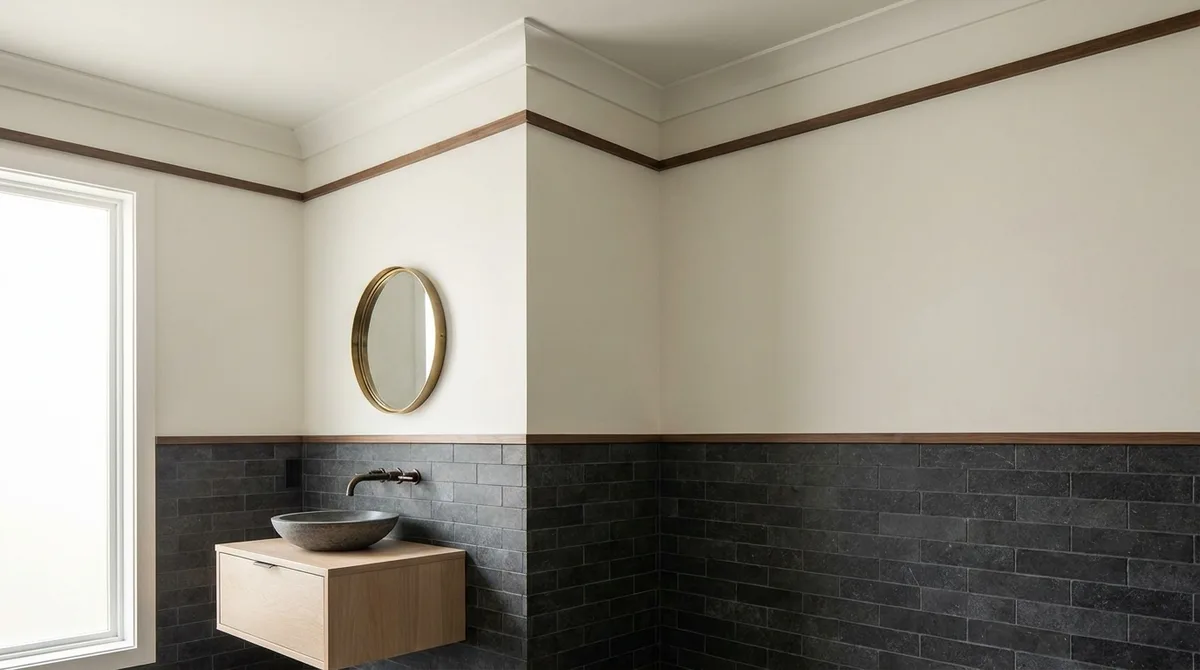
Trim fails because it is specified last and installed when everything else is done. By then, the timeline is compressed and the detail gets rushed. But that is not why it fails in a bathroom. Trim fails in a bathroom because it gets wet repeatedly, and the material is usually chosen for appearance rather than for what water does to it.
Softwood trim — pine, fir — absorbs water. If it is not sealed, it swells and twists. If the finish is paint, water finds the edges and works into the grain. The paint lifts at the edges. Over time, the trim rots. This is why softwood skirting in a bathroom behind a toilet, where water splashes every day, is a short-term decision. The trim might look fine for a year. After a few years, it softens and the paint is compromised.
Hardwood trim does better but is not immune. Veneered trim, where a thin hardwood face is glued to a softer core, delaminates when water gets between the veneer and the core. Solid hardwood swells and shrinks but is more stable than softwood. Pre-finished trim — trim that arrives sealed and finished from the factory — is better than trim painted on site because the edges are sealed at the factory and the back is sealed too.
The honest question is whether the room wants trim at all. Trim hides the junction between wall and floor. Without trim, that junction has to be finished neatly — sealed with caulk, or the wall brought down to the floor edge, or a floor detail that reads cleanly. These solutions work and cost less than trim that will rot in five years.
Scribing is fitting trim to walls that are not straight. In a bathroom, almost no walls are straight. The wall bows, the floor is not level, and the junction between them is a curve rather than a line. Trim has to scribe — the edge of the trim is cut to follow the curve of the wall so it sits tight. This is labour-intensive, but it is the difference between looking good and looking rough.
Pre-finished trim — trim stained and sealed at the factory — is better than trim that is painted on site because the finishing job is done in a climate-controlled environment. The back of the trim is sealed, the edges are sealed, and the face is finished to a standard. On site, paint and finish cannot be applied to the back of installed trim. The back stays exposed to moisture. Pre-finished trim, with the back sealed, is more durable.
The junction between trim and wall is sealed with caulk. Not all caulk is the same. Paintable caulk, silicone caulk for kitchens and baths, and urethane caulk all have different adhesion and flexibility. In a bathroom, silicone caulk rated for kitchens and baths is the right choice because it is flexible, waterproof, and lasts. This caulk sits in the joint between trim and wall, and it seals water out.