 Nanaimo Custom Bathrooms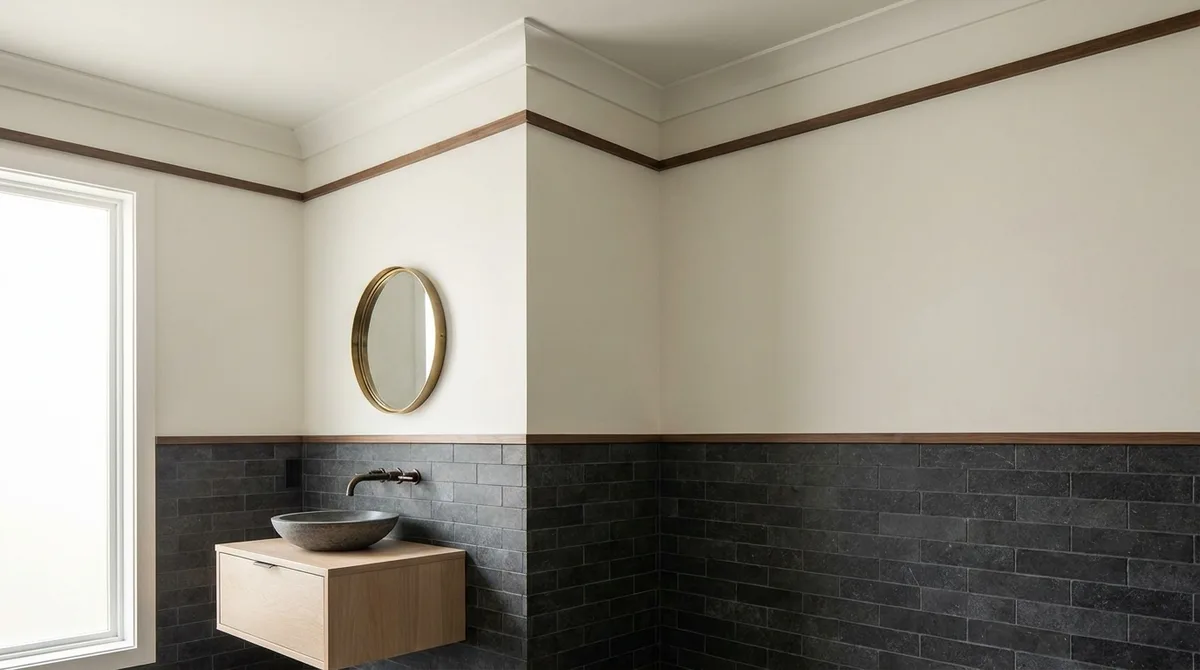
Tile covers the wet zone. Everything above that line — and everything on the walls outside the wet zone — still needs a finish, and that finish is not tile. The choice comes down to one hidden variable: how many joints does the finish have, and what happens when one of them works loose.
A painted wall starts with drywall. The drywall is one large plane, but it arrives in sheets. Those sheets have seams where they meet, and those seams are taped and filled. The tape is invisible under paint, but the joints are still there. If paint and humidity work on the tape over years, it can lift slightly and show as a line running across the wall. A whole wall of paint has relatively few joints — essentially at the seams between sheets.
Plaster is different. Plaster is applied over lath, and lath is a grid of thin strips. Every strip is one potential joint. Plaster bonds to the lath, but at the edges of each lath strip, there is a line where the plaster thickness changes or bridges. That line can be the start of a crack if humidity and temperature move the lath. Plaster is repairable — a crack can be patched invisibly — but the number of potential failure points is higher.
Panelling — whether wood, or panels that look like wood — has seams where panels meet. That seam is where two finished edges come together, and it is one of the most visible lines in the room. The seam does not usually fail, but it is a feature that catches the eye. If the wall moves, the seam can open slightly and look worse. Panelling is repairable, but a patch is always visible because the grain or pattern will not match.
Seamless trowelled finishes — venetian plaster, tadelakt, or other finishes trowelled on site — have no joints at all. The finish is one continuous plane. It is beautiful, and if humidity moves it, the damage is often invisible because there are no seams for cracks to follow. The trade-off is that these finishes are fragile. They are softer than paint and can be marked. They are harder to repair than paint. A patch on a seamless finish has to be feathered in and blended, and it is hard to make it invisible.
Sheet materials — panels that come in large sheets and are fastened to the wall — reduce the number of joints by making each joint much larger. A wall of sheet panels might have four seams instead of twenty. But each seam is a more prominent feature, and the seams are usually covered with battens or trim. The room reads differently because of them.
At the line where the wet zone ends and the dry wall begins, the finish has to transition. Paint meets tile at this line. Plaster meets tile. Panelling meets tile. That junction is a detail that gets decided early and executed carefully. Tile waterproofing ends at a certain height; the wall above it carries water up from splash and humidity, and the finish there has to shed water or at least not hold it.