 Nanaimo Custom Bathrooms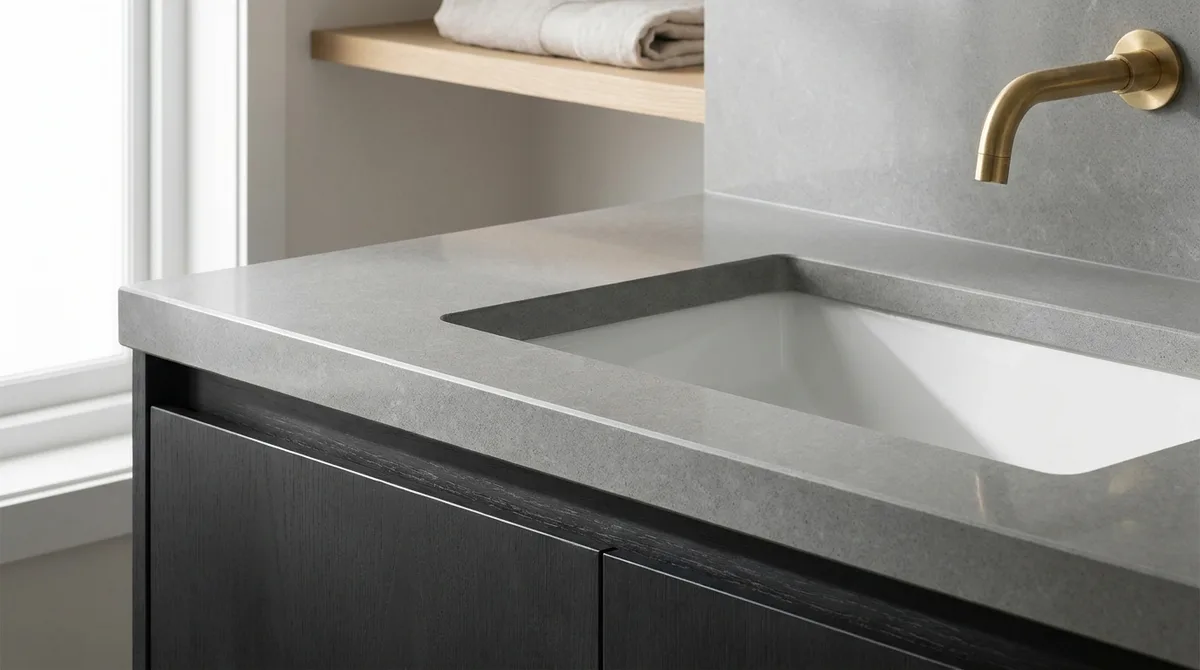
A fabricated countertop is built to do what a stock slab cannot. It carries features—an integral splash at the wall, a raised or recessed ledge, a waterfall return down the end of a peninsula. It spans unusual widths or depths. Two pieces are joined where a single slab cannot stretch far enough, the seam planned into the design rather than becoming a necessary evil. An edge is built up with a mitred profile so the top reads thicker than the material actually is, or edges are finished with a curve or profile that solid slabs do not offer.
The decision to fabricate is made when the design asks for something no catalogue inventory can provide. A tileable integral splash—part of the top itself, angled to shed water back onto the surface—is a fabricated detail. An integrated return on a peninsula, where the top wraps down one end and becomes a divider or a breakfast bar, is fabricated work. An edge that catches the light and reads as an intentional detail rather than the material simply stopping is fabricated. The fabricator takes your design intent and builds it into the top itself, during construction, so when installation day comes, the feature is already complete.
A matching top, if you want the new countertop to read as a continuation of a piece already in the room, is fabricated with its seams and joints positioned to align with the existing piece. Veining, patterns, or colour runs become part of the conversation with the fabricator—they lay out the slab so the visual flow makes sense from one piece to the next. The fabricator's job is not to make every top look new; it is to make this top look intentional, whether it is a one-off accent or a deliberate continuation of something already there.