Skip to content
Nanaimo Custom Bathrooms

Bathroom Countertops & Sinks

Undermount Sinks

The bowl hangs beneath the countertop. Positive, negative, or flush reveal—each reads differently and collects differently.

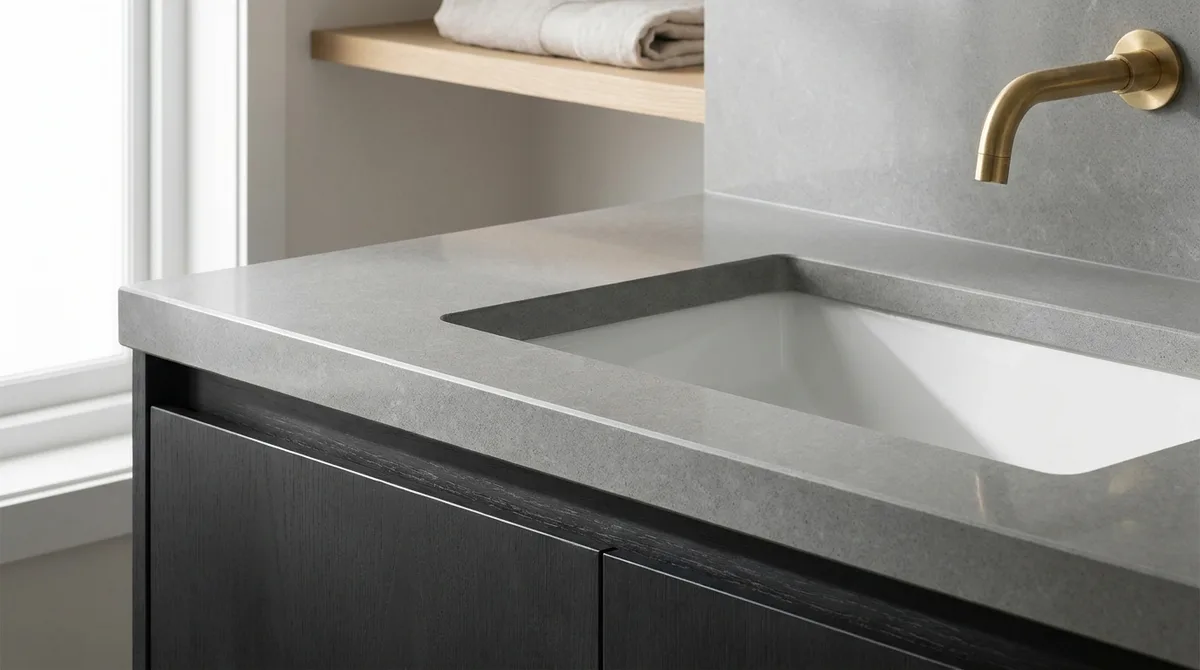
A honed quartz vanity top with an undermount basin and a wall-mounted brass faucet

What this involves

Undermount Sinks

An undermount sink is mounted from underneath the countertop. The bowl hangs from the underside of the top, creating an uninterrupted line from surface into basin. There is no visible rim sitting on top of the counter, as there is with a drop-in basin. The point is visual continuity and a cleaner sightline. What varies is the reveal—the gap between the edge of the cut-out and the rim of the bowl. A positive reveal is a gap you can see; the cut-out is slightly larger than the bowl. A negative reveal is the opposite; the bowl rim sits slightly proud of the surface. A flush reveal has bowl rim and surface at the same height.

Each reveal reads differently. A positive reveal creates a shadow line, visual separation between counter and bowl. A negative reveal appears to have no gap at all from normal viewing height; the bowl reads as sitting in the surface. A flush reveal is exact: bowl rim and surface at the same level, no lip in either direction. Each reveal collects differently; what sits in the shadow of a positive reveal is hidden, while what collects on a flush or negative reveal is visible.

The cut-out edge in an undermount basin is a visible, finished surface. It is not hidden under a rim. The edge of the hole in the countertop is touched and seen every day. It has to be a finished edge—sanded smooth on stone, polished on granite, sealed on porous material. This is the detail that decides whether an undermount looks intentional or unfinished.

The mount itself places load on the countertop material. The bowl is supported and fixed from underneath, and that load concentrates at the attachment points. Some materials are marginal for undermounting—thin engineered surfaces can flex, brittle materials can fail at the stress concentration. This is why material choice and undermount mounting are not entirely separate decisions. A material suitable for undermounting is one that can take that load without concern.

  • Licensed & insured
  • WorkSafeBC coverage
  • Written quotes & contracts
  • Built to BC Building Code

Why it matters

What you get

Undermount eliminates the rim

Visual line flows from counter into basin.

Reveal type creates different shadow

And visual separation.

Cut-out edge is a design detail

Finished and intentional rather than hidden.

Support is fixed and secure

Mounting the bowl solidly beneath the surface.

How it runs

The process

  1. 01

    Bowl mounted from underneath

    With supports or brackets fixed to the underside.

  2. 02

    Cut-out edge finished

    Appropriate to the material—sanded smooth on stone, sealed on porous surface.

  3. 03

    Reveal type set

    During fabrication and installation.

Questions

Frequently asked

Reveal is the gap between the cut-out edge and the bowl rim. Positive reveal creates a visible shadow line. Negative has the rim slightly proud. Flush is exact. Choice is about aesthetics—what visual line appeals to you and what shadow or gap you want to see.

The edge is visible every time you look at the sink and is touched when you lean against it. An unfinished or ragged edge looks careless. A smooth, sealed, finished edge looks intentional and reads as quality.

Support brackets or clamps attach the bowl to the underside of the countertop, fixing it so the bowl hangs securely. The mounting is set during installation and designed to carry the load of water and daily use.

Thin or brittle materials are marginal. Engineered surfaces too thin to support the load without flexing are not ideal. Stone with marginal edge strength may not be suitable. The best undermount materials are dense, strong stone or solid surface that can take the concentrated load.

Planning an undermount sink?

Reveal type and cut-out edge finish are design details that affect how the sink reads and functions.