 Nanaimo Custom Bathrooms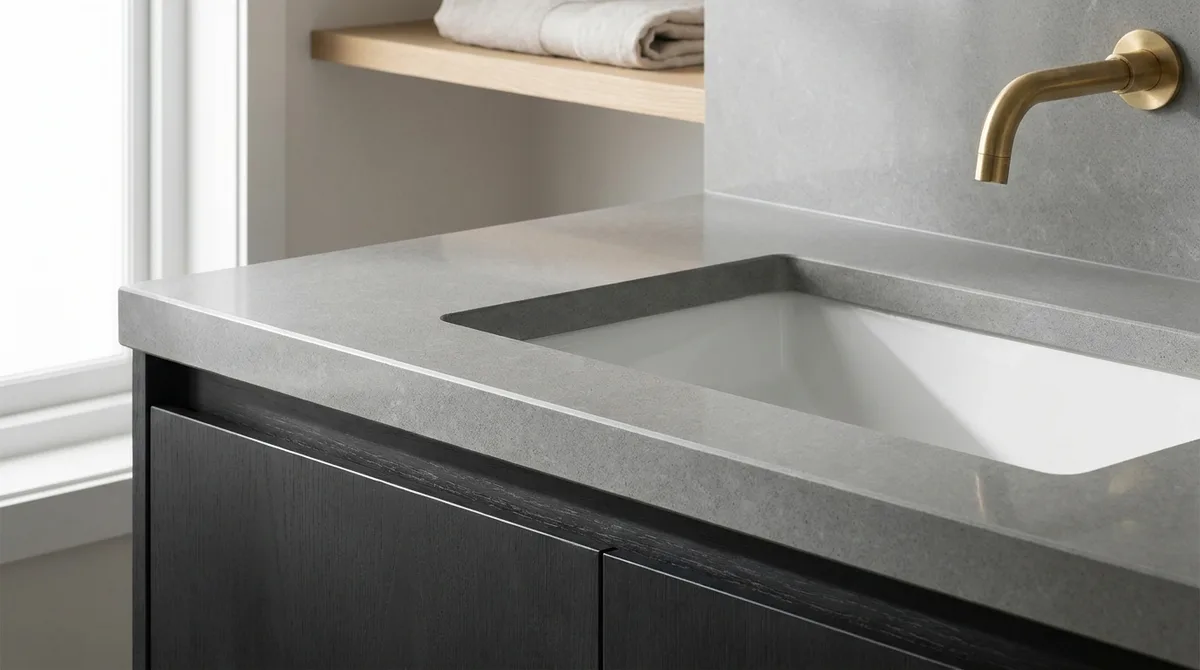
Quartz countertops are engineered stone—crushed quartz bound in a polymer binder, manufactured in a factory under controlled conditions. The point is predictability. What is in the sample is what arrives in the slab. Order the same product six months later, and a second slab will match the first one. Natural stone does not offer this. Every slab of granite or marble is unique. Engineered quartz offers certainty: this is the colour, this is the pattern, this is what you are getting.
The body of engineered quartz is non-porous—water, oils, and everyday stains do not soak in. A spill sits on the surface; it does not penetrate. This changes how the material behaves in daily use compared with porous stone. Sealing is not needed. Maintenance is simpler. The trade-off is in character: engineered stone is consistent and uniform, while natural stone is variable and unique. For some users, uniformity is the point. For others, it is exactly what they want to avoid.
Engineered patterns are designed to imitate natural stone—veining that looks like marble, granular patterns that echo granite, colours drawn from slate. At arm's length, the imitation reads convincingly. Close up, patterns are more regular, colour variation is more controlled, and the manufactured nature becomes obvious. The question is not whether you can see the difference; it is whether that difference matters to you when you are looking at your countertop from across the room every day.
Edge profiles in engineered stone are consistent. The material bonds uniformly, so profiles can be clean and detailed. A thin mitred edge reads as sharp and intentional. A bevelled or rounded profile is smooth and consistent from slab to slab. Engineered stone edges do not have the character of natural stone edges, but they do not have the risk, either—no worry about a fragile edge breaking or a thin mitré becoming vulnerable.