 Nanaimo Custom Bathrooms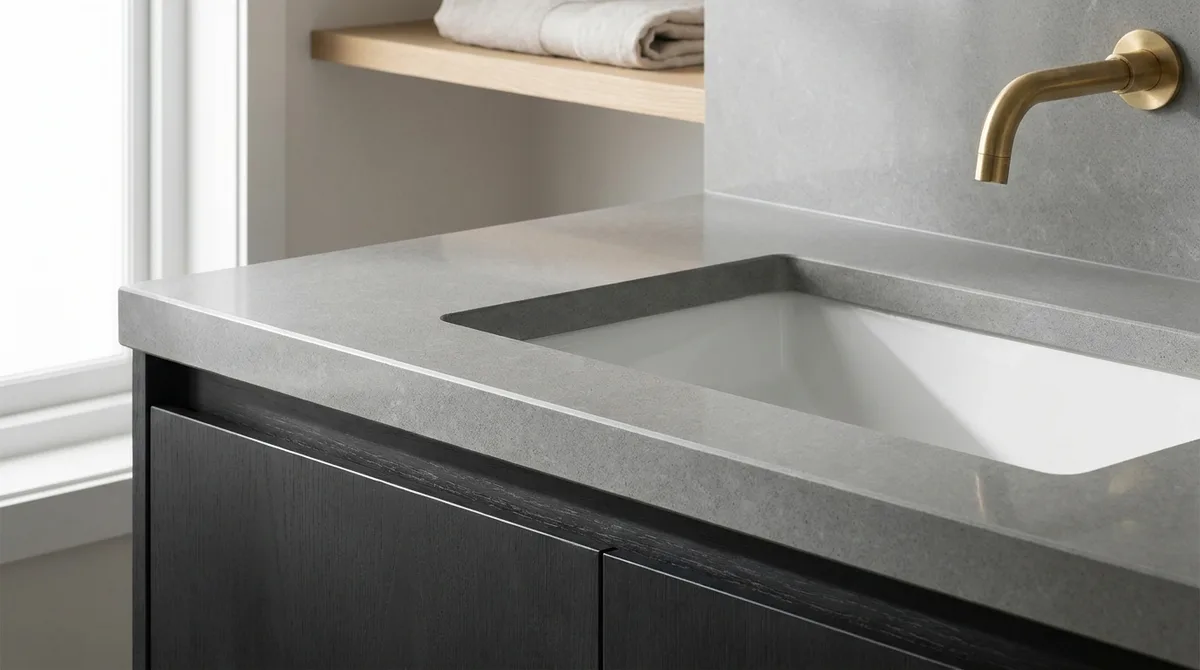
Solid surface is the only countertop material that allows a bowl to be bonded into the top so there is no rim, no reveal, no visible joint where bowl meets surface. The entire finished unit—top and basin—reads as one object. There is nothing to clean around; the junction is sealed and seamless. The same material and finish flow from the countertop into the bowl and back out again. This is not the case with any other material. Undermounted bowls in stone sit beneath the edge; vessels sit on top. Solid surface allows a bowl to disappear.
Joins in a long run are bonded and sanded flush. On any other material, a seam is visible as a line. In solid surface, the seam is sanded and filled so a long run reads as a single piece. The join is still there—a layer of adhesive and sanding—but it is not visible to the eye. For kitchens or bathrooms where visual continuity is important, this is a material advantage that no other countertop offers.
The surface can be sanded to remove scratching and refinished later. A scratch that would be permanent on stone can be addressed by sanding the area and resealing it. The finish is renewable in a way that engineered stone or natural stone is not. Thermoformed curves allow shapes that stone cannot be fabricated into. A coved upstand—a curved wall from the counter up—is possible in solid surface. Returns, inside curves, and complex geometry are all workable in a material that can be heated and formed to shape.
The trade-off is in image: solid surface reads as a manufactured product, not a natural material. It is chosen for performance and seamlessness, not for the character that stone brings. It is practical, capable, and honest about what it is. For a bathroom where the focus is on simplicity and ease of maintenance, it is a legitimate choice.