Skip to content
Nanaimo Custom Bathrooms

Bathroom Vanities & Cabinetry

Vanity Storage Solutions

Everything worth deciding about a vanity's storage happens inside the carcass, where a trap, two stops and a pair of runners are already using the space.

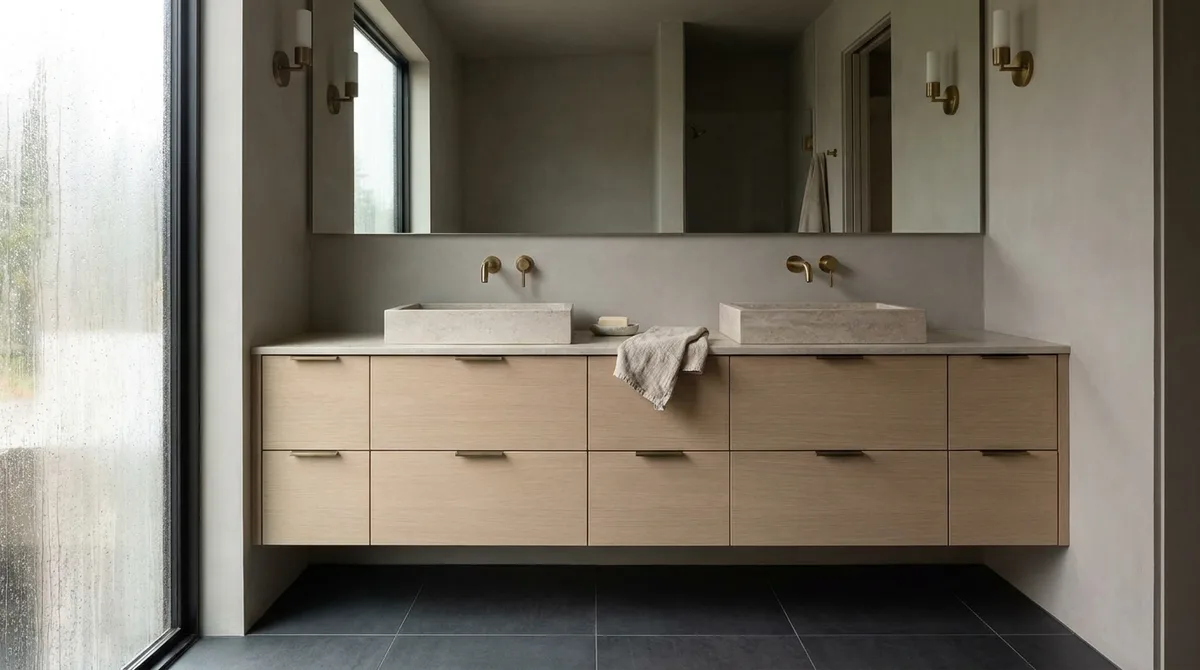
A floating oak vanity with two drawers and an undermount basin beneath a backlit mirror

What this involves

Vanity Storage Solutions

The inside of a vanity is never an empty rectangle, so setting out starts from measured positions rather than a standard drawer stack. A U-shaped box wraps the waste on three sides; a notched box clears it at the back only and keeps more of its own structure. Either way the cut-out needs 20 to 25mm of clearance all round, because a box that only just misses the pipe will rub and eventually jam. The notch should be stepped rather than simply cut away — a box with a bite out of its base racks under load.

Changing the plumbing buys more storage than changing the joinery does. A conventional trap and a pair of stops sitting mid-height in the middle of the opening dictate every box above and below them. Swapping to a slim or offset trap and lifting the waste higher up the wall will often release a whole drawer, and moving a pipe is far less work than fabricating a complicated box around one that did not need to stay.

With the obstruction resolved, the fit-out follows use. A drawer presents its entire footprint when opened, where a door and a shelf present only the front row. The most valuable box in a bathroom is the shallow one at the top, around 100 to 120mm, because small items disappear to the bottom of anything deeper, and deep boxes need dividers or a bottle grid to stay usable at all. Converting the toe recess into a shallow drawer recovers 100mm of height a plinth simply encloses, and the fixed panel under an undermount basin can be hinged as a tilt-out tray.

Hair tools are the one case needing services inside the cabinet. An outlet in a drawer keeps them plugged in and off the counter, and in a bathroom a receptacle needs ground-fault protection wherever it sits. On heat, the useful measure is a metal or heat-resistant liner a hot iron can be set down on; a ventilation slot mostly helps a damp brush dry.

  • Licensed & insured
  • WorkSafeBC coverage
  • Written quotes & contracts
  • Built to BC Building Code

Why it matters

What you get

Boxes set out from measured pipework

Cut-outs are drawn from the actual trap and stop positions with running clearance allowed, so drawers wrap the obstruction instead of stopping short of it.

The obstruction reduced first

A slimmer trap and a higher waste connection are considered before the joinery is designed, because that often releases a full drawer for very little work.

An interior planned around contents

Box depths, dividers and trays are decided from what is actually being stored, which is what stops a deep drawer turning into a pile with a front on it.

How it runs

The process

  1. 01

    Measure the interior obstructions

    Trap type and height, stop positions and the depth the pipework projects into the opening are recorded, since every internal dimension is derived from those.

  2. 02

    Simplify the plumbing where possible

    Options for a low-profile or offset trap and a raised waste are reviewed with the rough-in, and the drawer stack is then planned against the result.

  3. 03

    Fit out for the contents

    Box heights, dividers, trays and any powered drawer are specified against what the household stores, and the cable route is set before the boxes are made.

Questions

Frequently asked

Almost always, and the reason is visibility rather than volume. Behind a door, only the front row of a shelf is reachable and everything behind it is forgotten until a clear-out. A drawer brings its full footprint out to you, so nothing is stored twice and nothing expires at the back. The exception is something tall and awkward that has to stand upright.

Yes, and it is one of the more useful things to build in. The receptacle needs ground-fault protection like any other bathroom outlet, the cable is brought through a grommet rather than a bare hole, and it needs a service loop generous enough that opening the drawer fully never tugs the connection. Far easier to include at the build stage than to retrofit.

The ventilation matters less than the liner. A slot or grille helps a damp brush dry out and stops the interior smelling, but it does very little for an iron put away while still hot. What protects the box is a metal or heat-resistant tray the tool can be laid on, sized so nothing hot touches timber or a painted surface.

Plan the inside of the cabinet

The pipework is measured and the contents discussed before any drawer stack is drawn.